
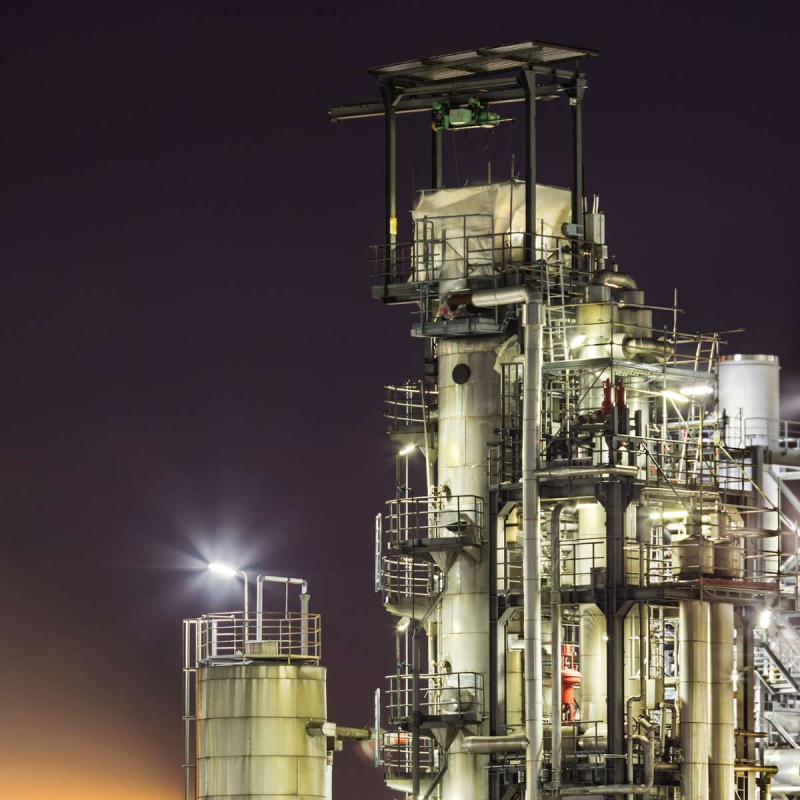
Fractional distillation is so deeply embedded in modern industry that it is often taken for granted. It operates quietly in refineries, chemical plants, and processing facilities across the world, separating complex mixtures into usable components with remarkable precision. Without it, many of the materials, fuels, and chemicals that underpin everyday life would simply not exist at scale.
At its core, fractional distillation is a method of separation. In practice, it is one of the most powerful tools industrial chemistry has ever developed.
The challenge of complex mixtures
Many of the most important substances used in industry do not arrive as pure compounds. Crude oil, natural gas liquids, and chemical feedstocks are mixtures made up of dozens or even hundreds of components, each with its own physical properties. Before these materials can be used, they must be separated reliably, efficiently, and at enormous scale.
Early chemists understood that different liquids boil at different temperatures, but turning this principle into a repeatable industrial process was far from straightforward. Simple distillation could separate substances with widely different boiling points, yet it quickly reached its limits when dealing with complex mixtures where boiling ranges overlapped.
Fractional distillation emerged as the solution to this problem.
From laboratory principle to industrial method
The underlying concept of fractional distillation builds on equilibrium and phase behaviour. As a liquid mixture is heated, components with lower boiling points vaporise first. By allowing vapour and liquid to repeatedly interact across a vertical column, components gradually separate according to their volatility.
This repeated cycle of vaporisation and condensation is what distinguishes fractional distillation from simpler methods. Each stage within the column acts as a small separation step, refining the mixture incrementally until distinct fractions can be drawn off at different heights.
Over time, chemists and engineers refined column design, tray configurations, and packing materials, transforming a laboratory technique into a continuous industrial operation capable of handling vast volumes of material.
Why it became indispensable
The impact of fractional distillation is most visible in petroleum refining. Crude oil enters a distillation column as a complex mixture and leaves as a series of usable fractions, including gases, petrol, kerosene, diesel, and heavier oils. Each fraction becomes the starting point for further processing or direct use.
Its importance extends well beyond fuels. Fractional distillation is central to the production of solvents, alcohols, polymers, speciality chemicals, and pharmaceutical intermediates. It enables consistent purity, predictable performance, and large-scale availability across countless supply chains.
By allowing industry to separate, standardise, and control chemical streams, fractional distillation helped move chemistry from small-batch production into the modern industrial era.
A process defined by control and precision
While the basic principle is simple, industrial fractional distillation is anything but. Temperature gradients must be carefully controlled, pressure adjusted to suit the mixture, and energy input balanced against separation efficiency. Small changes in operating conditions can significantly affect product quality and yield.
Modern distillation columns are therefore highly engineered systems. Advances in process control, instrumentation, and modelling have made separation more efficient and reliable, even as feedstocks have become more variable and specifications more demanding.
Despite these improvements, the fundamental physics and chemistry of fractional distillation remain unchanged. The same principles that govern a laboratory column apply equally to the towering structures found in refineries and chemical plants today.
Energy, efficiency, and the future
Fractional distillation is also one of the most energy-intensive operations in the chemical industry. Heating large volumes of material and maintaining precise temperature profiles requires significant energy input, making distillation a key focus area for efficiency improvements.
Current innovation centres on reducing energy consumption through improved heat integration, advanced column internals, and alternative separation techniques that complement distillation rather than replace it. In many cases, fractional distillation remains the most practical and reliable option, even as sustainability considerations become increasingly important.
Its continued use reflects a balance between proven performance and ongoing optimisation.
Why fractional distillation remains a modern miracle
Fractional distillation does not produce a single headline product, nor does it rely on a dramatic chemical transformation. Its importance lies in what it enables. By making complex mixtures manageable, it allows entire industries to function with consistency and scale.
From fuels and polymers to pharmaceuticals and speciality chemicals, fractional distillation underpins the materials that shape modern life. It is a reminder that some of the most impactful chemical processes are those that quietly impose order on complexity, day after day, across the global industrial landscape.
If you’re looking to source chemicals, get in touch with our team and find out what we can do for you.